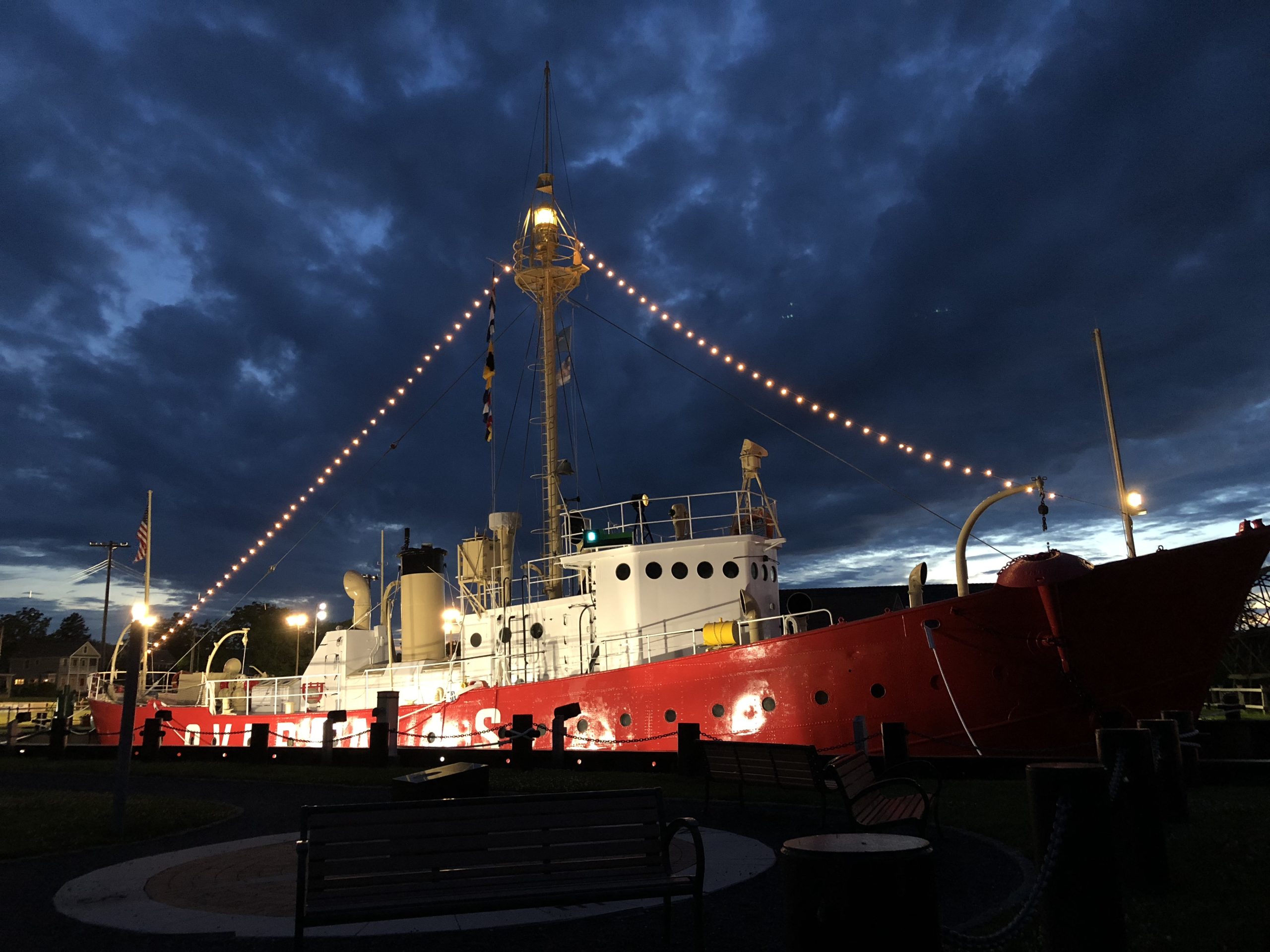
What is a Lightship?
A lighthouse that floats! It serves the same functions, such as a light to aid navigation at night, a horn to warn mariners in fog, and a radio beacon for longer-range navigation.
Lighting the Way
The Overfalls main aid to navigation was a 375 mm dual electric lantern located 57 feet above the water line. Rated at 15,000 candlepower, (approximately 1,000 watts), it flashed every 3 seconds from dusk until dawn. On a clear night it could be seen for 12 miles. The ship also had a dual diaphone fog horn with a range of 5 miles that sounded every 30 seconds in foggy weather.
A radio beacon with a range of 25 miles transmitted the call letters of the ship (NMJF) in Morse code. In foggy weather it was synchronized with the horn and broadcast every 30 seconds.
Overfalls Specifications
| Vessel Name | Overfalls (LV118 / WAL539) |
| Built | 1938 at Rice Brothers Shipyard, East Boothbay, Maine |
| Cost | $223,900 |
| Mast | Single |
| Dimensions | Length 114′; beam (width) 26′; draft 13’4″, weight 422 tons. |
| Engine | Single Cooper-Bessemer 300 hp, 8 cylinders with air starter. |
| Propeller | Steel, 7′ 2″ diameter, gear-driven |
| Maximum Speed | Nine knots (between 10 and 11 mph) |
| Primary Navigation Light | Dual 375 mm electric lens lanterns located 57 feet above the water line and rated at 15,000 candle power (1,000 watts). Flashed every 3 seconds at night, visible for 12 miles on a clear night. |
| Fog Horn | Dual air diaphones, switchable to single horn with a range of 5 miles, which would sound a three second blast every 30 seconds whenever visibility was less than two miles. |
| Radio Beacon (transmitter) | 25 mile range, which was synchronized with the fog horn (when in operation) so ships equipped with a radio direction finder could calculate the distance to the ship in obscure conditions. |
| Radar | RCA surface unit installed 1943 with a range of 15 miles. |
| Anchors | 7,000 pound mushroom type main, and 3,000 pounds auxiliary anchor. |
| Crew | 14 men served 2 weeks on and one week off. |
| Fuel Capacity | 12,400 gallons of diesel in 10 fuel tanks. |
| Fresh Water Capacity | 6,500 gallons in 4 fresh water tanks. |
| Ballast Tanks | 4 each with a total capacity of 10,000 gallons sea water. |
| Station Assignments | 1938 – 1957: Cornfield Point (CT) 1958 – 1962: Cross Rip (MA) 1962 – 1972: Boston (MA) |